Emerging Technologies in U.S.: 5 Innovations Reshaping Industries by 2025

The U.S. market is on the cusp of a technological revolution, with five key innovations poised to redefine industries by 2025, offering unprecedented opportunities and challenges for businesses and consumers alike.
The landscape of the U.S. market is perpetually in flux, driven by relentless innovation and evolving consumer demands. As we inch closer to 2025, a handful of emerging tech innovations are not merely optimizing existing processes but fundamentally reshaping entire industries. Understanding these pivotal shifts is crucial for businesses aiming to thrive and individuals seeking to navigate the future.
The rise of artificial intelligence and machine learning
Artificial Intelligence (AI) and Machine Learning (ML) are no longer confined to the realm of science fiction; they are actively transforming operations across virtually every sector in the U.S. From automating complex tasks to providing predictive insights, these technologies are becoming indispensable tools for efficiency and strategic decision-making. Their integration is not just about adopting new software, but about fundamentally reimagining workflows and customer interactions.
The impact of AI and ML extends beyond mere automation. These technologies are enabling businesses to process vast amounts of data at unprecedented speeds, uncovering patterns and correlations that human analysis would miss. This capability fuels personalized customer experiences, optimizes supply chains, and even accelerates scientific discovery. As AI models become more sophisticated, their applications will only broaden, touching more aspects of daily life and commerce.
AI-driven automation in manufacturing and logistics
Manufacturing floors are increasingly populated by intelligent robots and AI-powered systems that manage production lines with minimal human intervention. These systems enhance precision, reduce waste, and operate 24/7, significantly boosting output and consistency. Similarly, in logistics, AI algorithms optimize routing, manage inventory, and predict demand fluctuations, leading to more efficient and cost-effective delivery networks.
- Enhanced production efficiency and quality control.
- Reduced operational costs through automation.
- Optimized supply chain management and inventory forecasting.
- Improved safety in hazardous work environments.
The continuous evolution of AI and ML is fostering a new era of industrial capabilities. Businesses that embrace these advancements early are likely to gain a significant competitive edge, driving both innovation and profitability. The ability to leverage AI for complex problem-solving and predictive analytics is becoming a cornerstone of modern business strategy.
Quantum computing: a new era of processing power
Quantum computing represents a paradigm shift in computational power, promising to solve problems that are currently intractable for even the most powerful classical supercomputers. While still in its nascent stages, the U.S. market is seeing significant investment and research in this field, with projections indicating its disruptive potential across various high-stakes industries by 2025. This technology harnesses the principles of quantum mechanics to process information in fundamentally different ways.
Unlike traditional computers that store information as bits (0s or 1s), quantum computers use qubits, which can represent 0, 1, or both simultaneously through superposition. This allows for exponential increases in processing capability, opening doors to breakthroughs in areas such as drug discovery, materials science, and cryptography. The initial applications are likely to be highly specialized, targeting complex simulations and optimization challenges.
Early applications and potential impact
Financial institutions are exploring quantum computing for complex risk modeling and fraud detection, while pharmaceutical companies are interested in its ability to simulate molecular interactions for drug development. The defense sector also sees potential in quantum cryptography for secure communication. The promise of quantum computing is immense, although significant challenges in development and error correction remain.
- Accelerated drug discovery and materials science research.
- Enhanced financial modeling and risk assessment.
- Revolutionary advancements in cybersecurity.
- Optimization of complex logistical and supply chain networks.
The advancements in quantum computing, though slow and demanding, are setting the stage for a future where computational barriers are shattered. Companies investing in quantum research now are positioning themselves at the forefront of the next technological revolution, preparing for a future where previously impossible calculations become routine.
Advanced robotics and autonomous systems
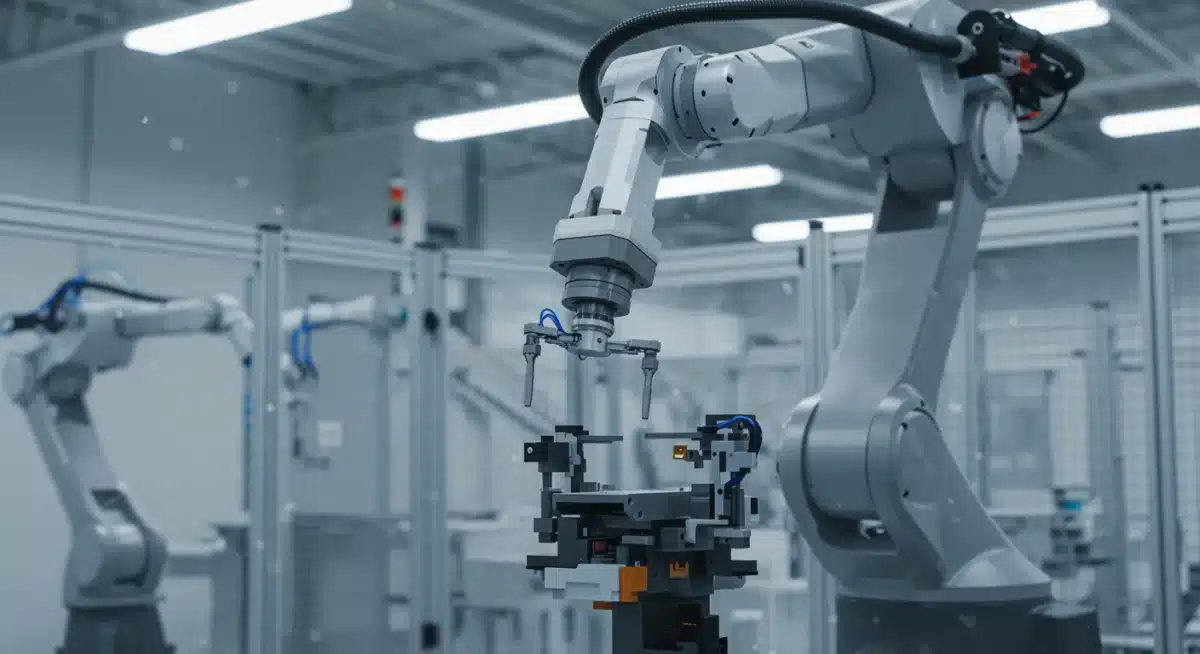
The integration of advanced robotics and autonomous systems is rapidly expanding beyond traditional manufacturing settings, penetrating sectors such as healthcare, agriculture, and service industries. These systems, often powered by AI, offer unparalleled precision, endurance, and the ability to operate in environments hazardous to humans. The U.S. market is particularly keen on leveraging these innovations to address labor shortages, improve safety, and enhance productivity.
Autonomous vehicles, drones, and sophisticated robotic assistants are becoming more common. In logistics, autonomous forklifts and delivery robots are streamlining warehouse operations, while in agriculture, robotic harvesters and autonomous tractors are optimizing crop yields. The versatility and adaptability of these systems are key to their growing adoption across diverse applications.
Robotics in healthcare and service industries
In healthcare, surgical robots assist with minimally invasive procedures, enhancing precision and patient outcomes. Autonomous robots are also being deployed in hospitals for tasks like delivering medications and sanitizing rooms, freeing up human staff for more critical duties. In the service sector, robotic baristas and cleaning robots are improving efficiency and customer experience.

- Increased operational efficiency and productivity.
- Improved safety in dangerous or repetitive tasks.
- Enhanced precision in complex procedures.
- Addressing labor shortages in various sectors.
The continuous development of advanced robotics and autonomous systems is creating a more automated and efficient operational landscape. Businesses that strategically implement these technologies will not only improve their bottom line but also enhance their capacity for innovation and responsiveness to market demands.
Sustainable energy solutions and smart grids
The imperative for sustainable practices is driving significant innovation in energy technology within the U.S. market. By 2025, we anticipate a substantial acceleration in the deployment of advanced sustainable energy solutions and the maturation of smart grid technologies. These innovations are critical for reducing carbon emissions, enhancing energy independence, and creating a more resilient energy infrastructure. The shift towards renewable sources like solar, wind, and geothermal is being bolstered by breakthroughs in energy storage and distribution.
Smart grids, powered by AI and IoT, are designed to optimize energy distribution, minimize waste, and integrate diverse energy sources seamlessly. They can dynamically adjust to demand fluctuations, predict potential outages, and even incorporate decentralized energy generation from homes and businesses. This intelligent infrastructure is fundamental to supporting a future powered predominantly by renewable energy.
Innovations in energy storage and smart grid management
Breakthroughs in battery technology, including solid-state batteries and advanced flow batteries, are making energy storage more efficient, cost-effective, and scalable. This is crucial for overcoming the intermittency challenges of renewable sources. Concurrently, AI-driven smart grid management systems are using real-time data to optimize energy flow, predict maintenance needs, and manage demand response programs, ensuring a stable and reliable power supply.
- Improved efficiency and reliability of renewable energy sources.
- Reduced carbon footprint and environmental impact.
- Enhanced energy independence and national security.
- Lower energy costs for consumers and businesses.
The push towards sustainable energy solutions and smart grids represents a monumental shift in how the U.S. generates, distributes, and consumes power. These innovations offer not only environmental benefits but also significant economic opportunities, fostering new industries and creating jobs while securing a more sustainable future.
Augmented reality (AR) and virtual reality (VR) advancements
Augmented Reality (AR) and Virtual Reality (VR) technologies are moving beyond gaming and entertainment to become powerful tools across various U.S. industries. By 2025, these immersive technologies are expected to revolutionize training, design, retail, and remote collaboration. The increasing accessibility of hardware and the sophistication of software are fueling their widespread adoption, offering new ways to interact with digital information and physical environments.
AR overlays digital content onto the real world, enhancing perception and providing contextual information, while VR creates entirely immersive simulated environments. Both technologies are proving invaluable for complex tasks, allowing users to visualize data, practice procedures, and collaborate in virtual spaces. Their potential to transform how we learn, work, and shop is immense.
AR/VR in industrial training and remote collaboration
In industrial settings, AR is used for maintenance and repair, guiding technicians through complex procedures with overlaid instructions and diagrams. VR provides immersive training simulations for high-risk professions, such as surgery or piloting, allowing practitioners to gain experience without real-world consequences. For remote teams, VR meeting spaces offer a sense of presence and collaboration that traditional video conferencing cannot match.
- Enhanced training and skill development through immersive simulations.
- Improved efficiency in maintenance and operational tasks.
- Revolutionized retail experiences with virtual try-ons and product visualization.
- More engaging and effective remote collaboration.
The continued advancements in AR and VR technologies are poised to redefine human-computer interaction and transform how businesses operate. From enhancing productivity to creating novel customer experiences, these immersive technologies are set to become integral components of the modern U.S. market, offering innovative solutions to a wide array of challenges.
The future of personalized medicine and biotechnology
The field of personalized medicine and biotechnology is undergoing a rapid transformation in the U.S., driven by advancements in genomics, bioinformatics, and gene-editing technologies like CRISPR. By 2025, these innovations are expected to move beyond research labs into mainstream clinical practice, offering highly tailored treatments and preventive strategies based on an individual’s unique genetic makeup and lifestyle. This shift promises a more effective and less generalized approach to healthcare.
This era of precision medicine aims to deliver the right treatment to the right patient at the right time, minimizing adverse effects and maximizing therapeutic outcomes. Biotechnology is also driving the development of novel diagnostics, advanced therapies, and regenerative medicine, promising cures for previously untreatable diseases. The ethical and regulatory frameworks surrounding these technologies are also evolving rapidly to keep pace with scientific progress.
Genomic sequencing and targeted therapies
Affordable genomic sequencing is enabling clinicians to identify genetic predispositions to diseases and tailor drug prescriptions based on an individual’s metabolism. Targeted therapies, developed through biotechnological research, are designed to act on specific molecular pathways involved in diseases like cancer, leading to more effective treatments with fewer side effects. This level of customization marks a significant departure from traditional, one-size-fits-all medical approaches.
- Highly individualized and effective medical treatments.
- Early detection and prevention of genetic diseases.
- Development of new cures for chronic and rare conditions.
- Reduced adverse drug reactions and improved patient safety.
The innovations in personalized medicine and biotechnology are poised to revolutionize healthcare, moving towards a proactive, preventive, and highly individualized model. These advancements hold the promise of significantly improving human health and longevity, presenting both profound opportunities and complex challenges for the U.S. healthcare system.
| Key Technology | Impact by 2025 |
|---|---|
| Artificial Intelligence & ML | Automates tasks, provides predictive insights, enhances efficiency across industries. |
| Quantum Computing | Revolutionizes complex problem-solving, drug discovery, and cryptography. |
| Sustainable Energy Solutions | Drives smart grids, reduces emissions, and enhances energy independence. |
| Personalized Medicine | Tailors treatments based on genetics, improving healthcare outcomes and prevention. |
Frequently asked questions about emerging technologies
AI and ML offer significant benefits, including enhanced automation, predictive analytics for better decision-making, optimized operational efficiency, and personalized customer experiences. These technologies are crucial for staying competitive and fostering innovation across various sectors.
While still emerging, quantum computing is expected to revolutionize fields requiring complex calculations, such as drug discovery, financial modeling, and materials science. By 2025, early applications will likely focus on specialized simulations and optimization problems, paving the way for broader adoption.
Sustainable energy solutions, coupled with smart grids, are vital for reducing carbon emissions, enhancing energy independence, and creating a resilient energy infrastructure. They promote the integration of renewables and optimize energy distribution, leading to a greener and more stable power supply.
AR and VR are moving beyond entertainment, transforming training, design, retail, and remote collaboration. They offer immersive experiences for skill development, enhance maintenance tasks with overlaid instructions, and create engaging virtual environments for both consumers and professionals.
Personalized medicine tailors healthcare treatments and preventive strategies based on an individual’s unique genetic makeup and lifestyle. It is significant because it promises more effective treatments, reduced adverse effects, and a proactive approach to health, moving away from generalized medical practices.
Conclusion
The U.S. market stands at the precipice of an unprecedented technological evolution, with emerging innovations poised to redefine industries by 2025. From the pervasive intelligence of AI and Machine Learning to the nascent power of quantum computing, and from the efficiency of advanced robotics to the sustainability of smart grids and the personalized approach of biotechnology, these shifts are not merely incremental. They represent fundamental transformations in how businesses operate, how consumers interact with products and services, and how society addresses its most pressing challenges. Embracing these technologies, understanding their implications, and strategically integrating them will be paramount for any entity looking to thrive in the dynamic economic landscape of the coming years. The future is not just arriving; it’s being actively built by these groundbreaking advancements.